
 March 13, 2026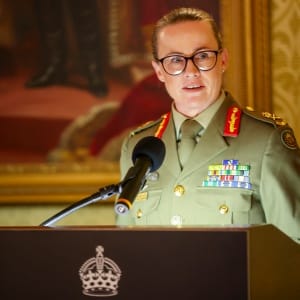
The fifteenth in the series of Ideas@theHouse events, which are joint presentations of Her Excellency, The Honourable Margaret Beazley AC KC, Governor of New South Wales, and the Royal Society of New South Wales, was held on the evening of Thursday, 12 March 2026, in the Ballroom of Government House, Sydney.
Lieutenant General Susan Coyle AC CSC DSM, Head of Space Command, Commander of the Defence Cyber and Information Domain, and leader of Defence’s National Support Division in the Australian Defence Force, was the speaker on this occasion, addressing the topic of ‘Navigating Strategic Uncertainty: Space, Cyber and National Support in a Fractured World.’
Her address presented a sober assessment of Australia’s strategic environment and the accelerating transformation of warfare. General Coyle contended that while the fundamental nature of war remained unchanged, its character is evolving rapidly due to advances in cyber operations, space dependence, artificial intelligence, autonomous systems, and information warfare across all five domains. The talk highlighted growing global instability, including conflicts in the Middle East, rising tensions in the Indo‑Pacific, and coercive state behaviour, noting that distance no longer insulates Australia and that the homeland is now part of the battlespace.
National security was framed as a whole‑of‑nation responsibility requiring close integration between the Australian Defence Force, government agencies, industry, academia, and society. Space and cyber were described as central enablers and contested domains essential to decision superiority, operational tempo, and deterrence. Information operations now increasingly shape perceptions and legitimacy, while logistics, fuel security, supply chains, and critical infrastructure resilience underpin national endurance.
General Coyle’s address stressed the importance of alliances, interoperability, and early collaboration with industry to accelerate innovation. Drawing on lessons from contemporary conflicts, the speaker emphasises urgency, adaptability, and resilience. She concluded by calling for sustained momentum, integrated national preparedness, and collective effort to ensure Australia can deter threats, endure disruption, and actively shape its future security environment.
The address was followed by a lively Q&A session moderated by Major General Ret’d Fergus MacLchlan AO FRSN. Key themes include Australia’s low likelihood of physical attack but high exposure to coercion in “grey zone” activities, particularly cyber and critical infrastructure threats. The speakers emphasised the importance of deterrence through alliances, especially with the United States and Five Eyes partners. The discussion covered cost‑effective warfare lessons from Ukraine, the role of emerging technologies, and collaboration with industry, academia, and global technology firms while maintaining sovereign control. Other topics include recruitment reforms, lateral entry of technical experts, space as a contested domain, challenges in defence research funding, and the responsibility of young people to engage ethically and critically in a digital world.
A recording of his presentation is now available on the Society’s YouTube channel. A gallery of images from the occasion is also available for downloading from the preceding link.


