
 March 30, 2026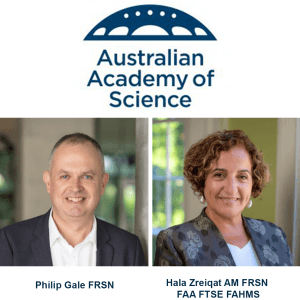
Professor Philip Gale FRSN of the University of Technology Sydney and the University of Groningen, and Professor Hala Zreiqat AM FRSN FAA FTSE FAHMS of the University of Sydney have been named as winners in the Academy of Science (AAS) Career Honorific Awards for 2026.
Professor Gale was awarded the David Craig Medal and lecture—one of the Academy’s career-level honorific awards—which recognises outstanding contributions to research of any branch of chemistry by active researchers.
Professor Zreiqat was awarded the Sunanne Cory Medal, another of the Academy’s career-level honorific awards, which recognises outstanding research in all of the biological sciences, being awarded in alternate years in the biomedical sciences and in all of the biological sciences excluding biomedical sciences. For 2026, the award was in the field of niomedical sciences.
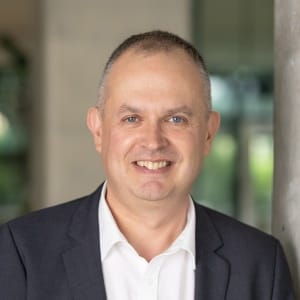
The Academy citation for Professor Philip Gale refers to his pioneering work on small molecules that transport anions across membranes, enabling potential treatments for cancer and cystic fibrosis. Membranes in cells consist of a bilayer formed from lipid molecules. The interior of this bilayer is ‘oily’, and ions and molecules that are charged, including species with a negative charge (known as anions), are only able to pass through special channel molecules present in the membrane. Professor Gale is developing small molecules that wrap around anions, giving them an ‘oily’ coat and allowing them to pass through the membrane.
These molecules have potential future applications treating diseases where the channel molecules in the membrane are faulty (such as cystic fibrosis) or where perturbing the anion concentrations within the cell triggers cell death (useful in compounds designed to treat cancer). Professor Gale is developing ways to switch on the transport properties of these molecules in the environments found within cancer cells, allowing them to be targeted to tissue requiring treatment so providing a potential new approach to the treatment of disease.
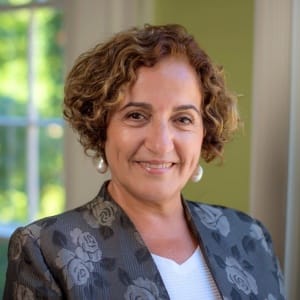
The Academy citation for Professor Hala Zreiqat states that she is an internationally recognised biomedical scientist whose pioneering research is transforming bone regeneration therapies. Her team developed the world’s first strong, bioactive synthetic ceramic scaffold that mimics natural bone, enabling the body to regrow tissue and restoring function after injury or disease. The team’s innovations, including patented materials now moving towards clinical use, offer new hope for millions affected by bone loss. Professor Zreiqat’s team also pioneered 3D-printed, patient-specific ceramic implants and novel surface treatments to enhance implant integration.
Her research spans cutting-edge areas such as anti-senescence biomaterials for ageing tissues and nanoengineered coatings for medical devices. Through extensive industry partnerships, her lab’s discoveries are progressing towards global clinical application. A distinguished leader and mentor, she has advanced interdisciplinary collaboration and championed diversity in STEM worldwide. Her research holds the promise of revolutionising musculoskeletal repair and improving the quality of life for patients around the world.
The Council of the Royal Society of NSW warmly congratulates Fellows Philip Gale and Hala Zreiqat on this latest recognition of the career impact of their research.


