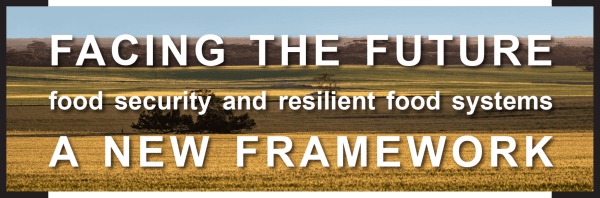
 “Facing the Future”
 “Facing the Future”
Update: Special registration rate for Members and Fellows of Australia’s Royal Societies
Date: Thursday and Friday, 8–9 October 2026
Time: 9.00 am – 5.00 pm AEDT
Venue: The Forum, Melbourne Connect, 700 Swanston St, Melbourne, Victoria
Bookings: RSNSW Members and Fellows, $250; Early-bird rate: $340.00 before 23 Sept. 2026; Full registration: $400.00.
Registration: Registration through Humanitix includes attendance, casual lunches and refreshments
Accommodation: Special rate at the Crowne Plaza Carlton
Conference Flyer: Downloadable from this link
Conference website: Via this link
Enquiries: via email to the Royal Societies of Australia
All are welcome
Purpose
The conference is aimed at a broad audience: food producers, distributors, retailers, government agencies, researchers, policy makers and so on. The underlying premise of the conference is that we have to achieve a transition to many new ways of addressing food and resilience issues now, which are consistent with Australia’s unique social and natural systems.
Background — the new normal
The economic, social and food production systems that we have taken for granted are being increasingly disrupted. Geopolitical shocks and changing climate and weather patterns show how dramatic these disruptions can be, with serious consequences for food security and jeopardy for the resilience of our current systems, from farm to consumer. Continual environmental degradation will limit food production potential. Rising inequality means more people will suffer food insecurity.
We can be confident that the overall framework we will have in the years to come will be different from now in ways we cannot easily predict. There will continue to be international and natural influences we cannot control. We must, therefore, review where we are now to identify potential problems which, if left unattended, may decrease food security and hamper achieving resilient food systems. The RSA Food Security conference will do this. In addition, it will examine how we develop new frameworks and delineate our preferred futures, and how we implement them. Simply extrapolating from history will not be good enough. We cannot become captive to the past.
Addressing the Issues
At the conference, experts from academia, government, industry, peak bodies and not-for-profits working in areas including food production, food safety and nutrition, trade, transport and logistics, social inclusion, national security and the environment will examine the issues that require attention now to bring together practical cross-sector solutions as the world around us changes. These issues include:
1. The burden of history – reliance on food customs, and production and farming techniques imported here by waves of migration and imposed on the different Australian circumstances – acclimatisation persists, even though the inherited and imported ways of thinking and patterns of living we have deployed here simply do not fit this land.
2. The changing world, with its cascading impact of geopolitical disruptions, technological developments, demographic changes, and damaging global changes to the natural world – climate change, coastal zone damage, soil degradation, biodiversity loss, and the continuing impact of diseases, pathogens and pest plants and animals.
3. Perverse laws and incentives affecting producers and consumers – maintaining our natural environment is fundamental to food production and resilient food systems, but environmental law is easily overridden by other laws, or by the way they are administered, and there is still no general agreement on incentives and information strategies needed to support a transition to effective food security and resilient food systems.
4. Poverty and health – poverty, inadequate access to health care and to dietary knowledge limit capacity to take advantage of food systems, regardless of how good they are.
Addressing the Issues
At the conference, experts from academia, government, industry, peak bodies and not-for-profits working in areas including food production, food safety and nutrition, trade, transport and logistics, social inclusion, national security and the environment will examine the issues that require attention now to bring together practical cross-sector solutions as the world around us changes. These issues include:
1. The burden of history – reliance on food customs, and production and farming techniques imported here by waves of migration and imposed on the different Australian circumstances – acclimatisation persists, even though the inherited and imported ways of thinking and patterns of living we have deployed here simply do not fit this land.
2. The changing world, with its cascading impact of geopolitical disruptions, technological developments, demographic changes, and damaging global changes to the natural world – climate change, coastal zone damage, soil degradation, biodiversity loss, and the continuing impact of diseases, pathogens and pest plants and animals.
3. Perverse laws and incentives affecting producers and consumers – maintaining our natural environment is fundamental to food production and resilient food systems, but environmental law is easily overridden by other laws, or by the way they are administered, and there is still no general agreement on incentives and information strategies needed to support a transition to effective food security and resilient food systems.
4. Poverty and health – poverty, inadequate access to health care and to dietary knowledge limit capacity to take advantage of food systems, regardless of how good they are.
Speakers include:
Professor Julianne Schultz – Griffith University
How we see ourselves and how this affects food issues
Professor Andrew Campbell – Triple Helix Consulting
Reviving land and sea care
Dr Mark Stafford Smith – CSIRO
Impacts of accelerating changes in the natural world
Professor Simone Warner – Agriculture Victoria Research
Better biosecurity efforts are critical
Professor Euan Ritchie – Deakin University
New environmental law – does it fall short?
Hon Professor Mary Graham – University of Queensland
Land, law and relationships
Dr Jessica Danaher – RMIT University
Our food plate is changing
Dr Courtney Quinn – University of Tasmania and CSIRO
Tipping points – challenges and opportunities
Conference outcomes
The two-day conference program aims to generate:
1. awareness of the changing world that provides the context for challenges to our food security and to our food systems, while highlighting the problems we will face from trying to continue with a business-as-usual approach, or from just making marginal changes within our existing framework,
2. suggestions for changes in the overall framework to transition to a brave new world within which food systems exist if the identified challenges are to be met, and if we are to maximise value from the many more specific initiatives now underway
3. useful inputs into the Feeding Australia: A National Food Security Strategy processes, into the AgriFutures project Systems Thinking: how agriculture can drive national resilience and into decision-making affecting inequality issues, the structure of the Australian economy and Australia’s international relations.


| Royal Societies of Australia | |
| Date: | Thursday, 08 October 2026, 09:00 AM |
| Venue: | The Forum, Melbourne Connect, 700 Swanston St, Melbourne, Victoria |
| Entry: | RSNSW Members and Fellows: $250;Early-bird: $340 before 23 September; Full registration: $400 thereafter |
In Person Event
All are Welcome

 31 December 2026
 Various face-to-face and online venues