
 April 8, 2026
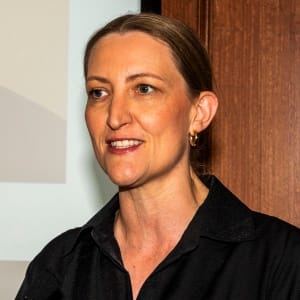
An audience of over 45 people who attended the Society’s 1339th Ordinary General Meeting at the State Library of NSW on 8 April 2026 enjoyed a enlightening and controversial presentation, ‘A drone by any other name‘, from Dr Catherine Ball, scientific futurist, tech influencer, and robotics expert, and Simon Masters, who is the Deputy Director of InnovateUK’s Future Flight program, on the uptake of drone technology in Australia and the UK. Simon Masters was unable to attend in person due to flight difficulties associated with the war in the Middle East. Accordingly, Catherine Ball led the presentation and the Q&A, with Simon Masters contributing his experiences through a recording made prior to the event.
In the talk, they discussed how ‘drones’ are best understood as a broad set of robotic, often autonomous systems (“physical AI”) that can operate in air, sea, or on land, spanning consumer photography, commercial services, and defence-linked technologies. Catherine Ball described how labels and politics have shaped funding and attention, with the term robotics ‘AI’ opening doors that the word ‘drones’ did not.
Catherine Ball began by recounting her 2012 work consulting for offshore oil and gas operations in Western Australia, where conventional surveying methods (boats, low-level planes, helicopters, satellites) were unsafe, expensive, or ineffective due to extreme heat, wind, and persistent cloud cover. She helped deploy long-range Aerosonde uncrewed aircraft using satellite communications to capture high-resolution environmental data for mangroves, coastal erosion, infrastructure, and marine wildlife, including turtle nesting patterns (with species identification) and invasive species detection. Early operational lessons included basic but costly mistakes (e.g., learning not to trust autofocus) and the heavy computing burden of early photogrammetry workflows. Despite world-first outcomes and awards, confidentiality restrictions limited publication and broader impact. She argued that Australia often develops innovations but fails to sustain them, citing Aerosonde’s sale to a US defence company.
Simon Masters followed up, outlining the UK’s Future Flight Challenge (launched in 2019), a £300m program designed to enable a ‘third revolution in aviation’ across drones, advanced air mobility, and low-emission propulsion. He emphasised ecosystem-building—regulation, public acceptance, skills, and partnerships—so that technology wasn’t just ‘shiny toys’ that nobody can use. Although the UK has made progress and backed projects like medical logistics and Antarctic research, large-scale commercial drone operations remain limited due to regulatory pace, investment hesitation, and the need for launch customers.
Catherine Ball then closed their presentation by contrasting Australia’s early lead with fragmented strategy, underused test sites, uneven funding, and missed opportunities, while noting successes (e.g., Google Wing deliveries, CASA’s sub-2kg deregulation) and the growing importance of counter-drone systems and emerging flying taxi/eVTOL trends.
A video recording of the presentation and Q&A session is now available on the Society’s YouTube channel, while a collection of images from the occasion is also available for viewing and downloading.


