
 June 10, 2026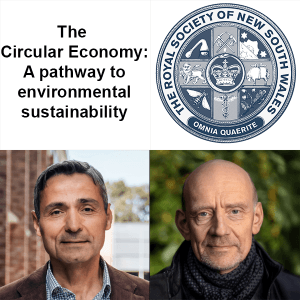
On Wednesday, 10 June 2026, an audience of over 50 people who attended the 1341st Ordinary General Meeting of the Royal Society of NSW heard a most illuminating presentation, panel session and audience Q&A on the topic of ‘The Circular Economy: A pathway to environmental sustainability?‘, deliver by Professor Sami Kara FRSN FCIRP FACATECH of the School of Mechanical and Manufacturing Engineering at UNSW Sydney and Professor Michael Hauschild of the Department of Environmental and Resource Engineering at the Technical University of Denmark.
In their presentation, Professors Hauschild and Kara examined whether the circular economy can genuinely deliver environmental sustainability, arguing that circularity and sustainability are often treated as synonymous when they are not.
Professor Hauschild began by framing the sustainability challenge: since the mid-20th century, population, affluence, and economic activity have grown rapidly, but so have environmental pressures such as greenhouse gas emissions, ocean acidification, biodiversity loss, and chemical pollution. Using the IPAT equation (which is shown in the presentation slides), he explained that environmental impact is driven by population, affluence and technology. While technology can become more eco-efficient, efficiency gains are often offset by rebound effects, where cheaper or more efficient products lead to increased consumption. Michael Hauschild distinguished between relative and absolute sustainability. Life cycle assessment can show whether one option is less damaging than another, but not whether it stays within planetary limits. Absolute sustainability requires meeting present and future human needs within biophysical boundaries, including climate and ecosystem limits.
Professor Kara then focused on circular economy strategies, noting that many are not new but have evolved from earlier ideas such as closed-loop systems, industrial ecology, remanufacturing and cradle-to-cradle design. He reviewed strategies including recycling, reuse, remanufacturing, product-life extension, sharing models, service-based business models, and dematerialisation through digital substitution. He explained that these strategies can reduce material use and environmental impact under ideal conditions, but they depend on assumptions such as one-to-one displacement of virgin materials, effective markets for reused goods, durable product design, and limited rebound effects.
Their presentation concluded that circular economy strategies alone are insufficient to achieve absolute sustainability. Recycling and recirculation cannot fully close material loops, and even strong efficiency gains may not offset rising population and affluence. In some cases, circular strategies can even increase environmental impacts if they stimulate additional consumption. The key message is that a circular economy must be accompanied by broader socioeconomic change and genuine demand reduction to decouple human wellbeing from continued material growth.
A video recording of the presentation and Q&A session is now available on the Society’s YouTube channel, while a collection of images from the occasion, which also includes the presentation of member certificates, is also available for viewing and downloading.


