
 December 29, 2025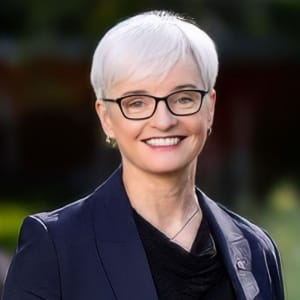
The Society was deeply saddened to learn of the death of former Fellow and award winner, Professor Emma Johnston, the 21st Vice-Chancellor of the University of Melbourne and its first female Vice-Chancellor. Her passing was announced by the University of Melbourne on Monday, 29 December 2025. She had been Vice-Chancellor since February 2025.
Professor Johnston was a sixth-generation Melburnian and an alumna of the University of Melbourne, graduating with a Bachelor of Science (1998) and a Doctor of Philosophy (2002) degrees, and being awarded an Honorary Doctorate of Science by the University in 2023.
She established her academic career at UNSW Sydney, where she rose to the position of Pro Vice-Chancellor (Research) and Dean of Science, before taking the role of Deputy Vice-Chancellor (Research) at the University of Sydney in 2022, a position she held until late 2024 before moving to Melbourne. During her research career, she published 185 peer-reviewed journal articles and supervised more than 35 higher degree students.
Professor Johnston was an outstanding marine ecologist, a leading authority in marine science and conservation, a sustainability and diversity champion, and a chief author of the Australian State of Environment Report 2021. During 2018–2019, she served as the President of Science and Technology Australia, during which time she was recognised for her strong advocacy of research and industry engagement in that role.
She was a high-profile science communicator, a regular media commentator, and the co-presenter of the Foxtel/BBC television series, Coast Australia, in 2015. She won the Eureka Prize for Promoting Understanding of Australian Science Research in 2015, and, before that, in 2012, she was named as the NSW Scientist of the Year for Excellence in the Biological Sciences.
Professor Johnston became a Fellow of the Royal Society of NSW in 2016 and was awarded its Clarke Medal for 2018. In August 2023, she delivered the lecture ‘Ideas for Marine Stewardship and Sustainability in a Time of Acceleration‘ in the Ideas@theHouse series, jointly hosted by Her Excellency the Honourable Margaret Beazley AC KC, Governor of NSW and the Royal Society of NSW.
In the 2018 Queen’s Birthday Honours, Professor Johnston was made an Officer of the Order of Australia for ‘distinguished service to higher education, particularly to marine ecology and ecotoxicology, as an academic, researcher, and administrator, and to scientific institutes’. She was elected a Fellow of the Australian Academy of Technological Sciences and Engineering in 2019 and a Fellow of the Australian Academy of Science in 2022. In recent years, she has served as a Director of the CSIRO and the Great Barrier Reef Marine Park Authority, and as a Governor of the Ian Potter Foundation.
The University of Melbourne Chancellor, Ms Jane Hansen AO, paid tribute to Professor Johnson.
‘Professor Johnston made a significant and meaningful contribution during her all too-brief time as our Vice-Chancellor,” Ms Hansen said. “Her extensive experience as a leader in education and research, her understanding of the increasingly complex university environment and her care for our entire community leaves an imprint that belies her short tenure. Significantly, Professor Johnston brought a tone of optimism and energy to our University, with her insight, experience and most of all her belief in all who are part of this community. She had an unwavering commitment to our students. Be it cost-of-living pressures, to scholarships, to teaching, to their research – she did everything she could to ensure our students were best equipped to achieve their goals. Most of all, she just liked spending time with them to hear their stories. They were her inspiration.’
‘Emma used her extraordinary communication skills to promote science, belief in the value of science, and the capacity of women and girls to study science as she herself did so brilliantly, helping us to better understand and protect our marine communities and coastal waterways. In 11 short months, she helped our University focus its collective intelligence on how best to advance its crucial academic mission, in which she so strongly believed, through a new strategy called Resilience. This is a loss not only to our University, the higher education sector, the research and science sectors, but to the nation. It will be felt by all those who had the privilege to know and work with her.’
Professor Johnston, who was 52, died of complications associated with cancer. Her husband and two children survive her.
The Society extends its sincere condolences to her family, friends, and colleagues at this sad time.


