
 August 5, 2026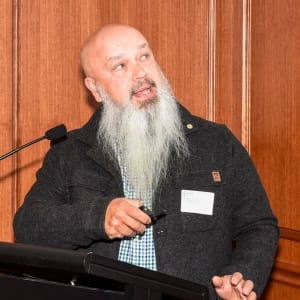
On Wednesday, 5 August 2026, an audience of approximately 40 people who attended the 1343rd Ordinary General Meeting of the Royal Society of NSW heard an insightful, passionate and personal talk that brought together Indigenous culture and Western science. The presentation, titled ‘The Importance of Understanding Water and Climate Change for Aboriginal People‘, was delivered by Professor Bradley Moggridge FRSN FTSE, Associate Dean (Indigenous Leadership and Engagement) of the Faculty of Science, University of Technology Sydney.
Professor Bradley Moggridge’s presentation centred on the deep cultural, legal and environmental importance of water for Aboriginal peoples, especially through his Kamilaroi identity and work in groundwater, climate and Indigenous knowledge systems. He began by grounding the talk in Country, family, ancestors and cultural responsibilities, explaining that water is embedded in songs, stories, law, ceremony, art and survival. He argued that Aboriginal knowledge represents thousands of generations of observation, testing and adaptation, yet is still often dismissed as myth rather than recognised as science.
Professor Moggridge outlined major water and climate crises in Australia, including droughts, floods, fish kills, biodiversity loss and river degradation, and showed how these events affect both ecosystems and cultural obligations. He described Aboriginal connections to groundwater, springs, ceremonial places, burial sites, cultural species and indicators such as frogs, crayfish and emus, which can signal environmental change. He also critiqued Australian water policy, arguing that land and water reforms have further excluded Aboriginal peoples from ownership, decision-making and access.
He identified as a major theme the need for research to be Indigenous-led, community-controlled and grounded in respectful methodologies such as yarning, storytelling, circular learning and co-design. He discussed various projects with communities on cultural indicators, drought resilience and water knowledge, as well as efforts to shift Aboriginal people from being researched to being researchers.
The presentation also highlighted global climate work, including IPCC involvement, Indigenous groundwater declarations and calls for stronger recognition of Indigenous knowledge in science, policy and education. Professor Moggridge continued with some recommendations: Indigenous knowledge in curricula, funded research networks, national water strategies guided by First Peoples, a Commissioner for Country, and continued advocacy for healthy water and Country.
A video recording of the presentation and Q&A session is now available on the Society’s YouTube channel, while a collection of images from the occasion is also available for viewing and downloading.


